Ottobock Releases One of the First-Ever Community-Built Image Libraries to Improve Representation of People with Limb Loss and Limb Differences in AI

The #DearAI [Community Library], powered by Microsoft, built and annotated by people with limb loss and limb differences, is now publicly available on Hugging Face to give AI systems an accurate, community-defined picture of disability for the first time.
AUSTIN, Texas, July 22, 2026 /PRNewswire/ — Ottobock, a global MedTech champion in prosthetics, neuro-orthotics and exoskeletons, today announced the public release of the #DearAI Community Library. The initiative is one of the first-of-its-kind open-source datasets of images depicting people with limb loss in everyday life created, selected, and annotated by the community itself, powered by Microsoft.
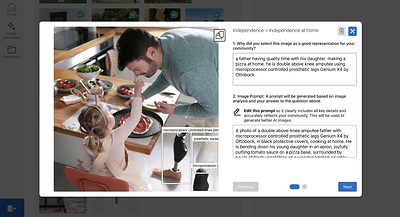
The library is now freely available at https://huggingface.co/ottobock and represents a significant step forward in addressing one of AI’s most persistent blind spots: the near-total absence of people with disabilities, and people with limb loss and limb difference in particular, from AI-generated imagery. AI systems will now have accurate representation of how amputees or people with limb differences live their lives.
“AI can only imagine what it has already seen and it has never truly seen the real lives of people with limb loss or limb differences. With the #DearAI Community Library, we are changing that,” said Martin Böhm, Chief Experience Officer at Ottobock. “This initiative is about contribution: giving AI something real to learn from, built by the people whose lives it has never accurately reflected. The community shaped every decision, and that is what makes this library different.”
AI Has Never Truly Seen Life with Limb Loss
As AI-generated imagery becomes more prevalent across media, marketing, and daily life, research has confirmed what the disability community has long experienced firsthand: AI systems overwhelmingly fail to reflect the reality of life with a disability.
Across 444 AI-generated images spanning 37 occupations, not a single person with a visible disability appearedi. When disability does appear in AI-generated images, nearly 100% of depictions default to a manual wheelchair — rendering the lived experience of prosthetic users, and the full diversity of the disability community, effectively invisible. When people with limb loss do appear, the images are actively misleading, defaulting to exaggerated bionic or cyborg aesthetics that bear no resemblance to real life.
These failures are not neutral. Research confirms they cause measurable harm — reinforcing perceptions of disability as tragic, incapable, and other-than-normal, and erasing the diversity of lived experience to a narrow set of stereotypesii.
A Library Built By the Community, For AI
The #DearAI Community Library was built on a simple but powerful premise: If AI learns from the data we give it, then those most affected by misrepresentation should have a voice in shaping that data.
An international group of Ottobock prosthetic users — with upper and lower limb differences — worked within Microsoft’s Community Library Creator to define ‘preferred representation.’ Drawing on Ottobock’s own rich image libraries as well as user submissions from across the globe submitted images and videos, which ambassadors then selected and annotated against community-defined standards for AI imagery. The result is two datasets of AI-interpretable images, one focused on upper limb loss and difference (Limb Difference & Prosthetic Representation Dataset – Upper Limb (LDPR–UL), one on lower limb loss and difference (Limb Difference & Prosthetic Representation Dataset – Lower Limb (LDPR–LL), capturing people in the everyday moments AI has not yet learned to see: as parents, colleagues, friends, athletes, and community active members.
“Representation in AI matters because it shapes how people see themselves and others,” said Neil Barnett, Microsoft’s Chief Accessibility Officer. “We’re committed to image generation models that create authentic, respectful, and positive representations of people with disabilities. Ottobock’s community library demonstrates what’s possible when communities are empowered to define good representation for themselves rather than having it defined on their behalf. This is the kind of community-led approach that responsible AI development requires.”
The library is published on Hugging Face and is freely accessible to anyone working with AI, from researchers and developers, to brands and creative agencies and individual creators.
“I spent my career proving what is possible for people with limb loss. But when I searched for images of someone like me, simply living everyday life, AI came up empty. This library is for every person with a prosthetic who has felt invisible in the world AI is building. We built it for ourselves and now it belongs to everyone,” Noah Elliott, Three-time Paralympian, Two-time Gold Medalist and Ottobock Ambassador.
The Community Library is the foundation of #DearAI, one of the first global campaigns made for AI, not with AI. Launched by Ottobock, the campaign brings together more than 60 ambassadors and community members from across the world who have written personal letters directly to artificial intelligence, sharing the lived experiences and everyday realities that AI-generated imagery has never reflected. A full list of participating ambassadors and additional campaign information is available for global audiences at https://www.ottobock.com/en-gb/ottobock-dear-ai and for U.S. audiences at https://www.ottobock.com/en-us/ottobock-dear-ai.
About Ottobock
Ottobock, a listed global MedTech champion, combines over 100 years of tradition with outstanding innovative strength in the fields of prosthetics, neuro-orthotics and exoskeletons. Ottobock develops innovative fitting solutions for people with limited mobility and is driving the digitalization of the industry. Founded in Berlin in 1919, the company has business activities in 45 countries with nearly 9,300 employees (FTEs) worldwide and operates the largest international patient care network with around 420 patient care clinics. Ottobock is shaping the future of human bionics with a strong R&D ratio in the products and components business and over 2,600 patents and patent applications. Ottobock’s mission of improving freedom of movement, quality of life and independence is deeply rooted in the company’s DNA, as is its social commitment: Ottobock has been a partner and supporter of the Paralympics since 1988.
i Sadeghiani, 2025, JEOD, 14(1): 119–130
ii Mack et al., 2024, ACM CHI
 View original content to download multimedia:https://www.prnewswire.com/news-releases/ottobock-releases-one-of-the-first-ever-community-built-image-libraries-to-improve-representation-of-people-with-limb-loss-and-limb-differences-in-ai-302831291.html
SOURCE Ottobock